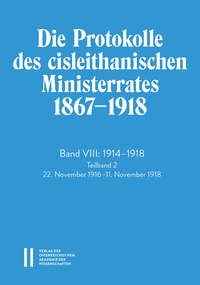
The minutes of the Council of Ministers of the Habsburg Monarchy contain everything the governments discussed. Therefore, they were secret—and often contained decisions whose effects are still felt today. This volume covers the last two years of the First World War: from the death of Franz Joseph on November 21, 1916, to Karl's resignation from all offices on November 11, 1918. A total of five prime ministers succeeded one another: Koerber, Clam-Martinic, Seidler, Hussarek, and Lammasch. In many matters, the Council of Ministers found it hard to govern and could only react: in May 1917, Parliament reopened and the governments were forced to secure majorities among the diverging national factions. Major problems had to be solved: the poor economic situation, social hardship, and insecurity, which culminated in strikes and uprisings. At the same time, the dualist system was in crisis—economic relations between Austria and Hungary could not be regulated, and Hungary was pushing for the division of the joint army. However, the Council of Ministers also made decisions that had an impact long after the war—for example, it initiated a systematic social policy and created new institutions such as Europe's first Ministry of Health and the Ministry of Social Affairs. Many of these topics from the First World War are explored here for the first time in great depth—including a secret protocol on the division of the joint army.